The 50 Most Relevant countdown rolls on with a spotlight on Matt Roberts, the Sydney Swans’ rising star, and his potential for the 2025 AFL Fantasy & SuperCoach season.
In this episode, MJ Want is joined by DR to break down:
Roberts’ 2024 performance and his evolving role in the Swans lineup 🦢
How Sydney’s team dynamics influence his scoring potential 📊
Key preseason strategies, including bye rounds and draft tactics💡
Exclusive updates on the Super Coach Swordplay brand and what’s coming next 🔥
Whether crafting your Classic team or planning Draft picks, this episode has the insights you need to make an informed choice.

Nick Daicos has made an indelible mark on the AFL landscape in just two short years, showcasing a career trajectory many veterans would envy. From clinching the Rising Star award to being adorned with an Anzac Day medal, earning his inaugural All-Australian honours, and even securing a premiership medal, Daicos’s contributions to the game have been spectacular.
His remarkable journey, however, was marred by a late-season injury, which arguably was the only thing standing between him and the prestigious 2023 Brownlow Medal.
Nick Daicos, in just his second AFL season, has rapidly become one of fantasy football’s most valuable assets, especially in AFLFantasy and SuperCoach formats. In AFLFantasy, he notched an impressive average of 108.8 points per game, with 14 games scoring over 100 points. Six of these games saw him surpass the 120-point mark, including a standout performance that earned him a career-high score of 150.
Of equal importance, he posted only two scores below 80 points throughout the season, one of which came in a challenging match where he was heavily tagged by Finn Maginness and also suffered an injury. Despite these hurdles, Daicos finished the season as the top defender by average, outperforming notable midfielders like Connor Rozee, Caleb Serong, and Christian Petracca.
In the SuperCoach, Daicos’s performance was equally stellar, with an average score of 117 points per game. He tallied 15 games with scores in the triple digits, cementing his position as the top defender by average and ranking 7th overall, above esteemed players such as Jordan Dawson, Rowan Marshall, and Tom Liberatore. Even when faced with tags and injuries, Daicos’s remarkable consistency and scoring ability underscore his immense value in fantasy leagues and his pivotal role as a defender in fantasy lineups.
Nick Daicos’s transition to spending more time in the midfield has significantly boosted the value of his fantasy football. Analyzing his performance, it’s evident that his scoring potential escalates with increased midfield attendance. Specifically, in the 12 matches where Daicos attended at least 35% of centre bounces, his AFLFantasy average soared to 107.5, while in SuperCoach, it reached 112.4. This distinction becomes even more pronounced in games where his centre bounce attendance spiked to 65% or more, showcasing averages of 116 in AFLFantasy and an impressive 121.8 in SuperCoach. Such statistics underline Daicos’s burgeoning prowess as he delves deeper into midfield roles and hints at a ceiling that has yet to be fully explored.
Daicos’s ability to elevate his game further into the midfield realm, combined with his already impressive stats in only his second season, sets the stage for what could be an extraordinary career.
Navigating the decision to start or target Nick Daicos as an upgrade hinges on several key narratives that fantasy football coaches must consider. The infamous Finn Maginness tag game in Round 4, compounded by an injury to Daicos, is a cautionary tale. While some in the fantasy community might be tempted to exclude this outlier to boost Daicos’s averages to 112 in AFLFantasy and 120 in SuperCoach, it’s a reminder of the inherent risks and the complexity of relying too heavily on selective data to fit a narrative.
Opting to wait and target Daicos as an upgrade revolves around strategic considerations, including:
The Early Bye Round: Collingwood’s absence in Round 5 offers a strategic pause, allowing coaches to assess Daicos’s early-season form and tag susceptibility.
Tagging Threats: Beyond the Finn Maginness game, the potential for Willem Drew’s tag in Round 6 looms, hinting at challenging matchups that could affect Daicos’s scoring and, by extension, his price.
Price Dynamics: The combined effect of these early challenges presents a scenario where Daicos might be acquired at a more favourable price point post-bye, aligning with a strategy to maximize value from premium selections.
Conversely, the argument for starting with Daicos underscores his unparalleled status in fantasy backlines, characterized by:
Dominance and Potential: As the preeminent defender in fantasy, Daicos’s blend of skill, role, and scoring potential sets him apart, suggesting that early investment could secure a cornerstone for fantasy defences.
Preparation and Adaptation: The Magpies’ preseason focus on mitigating the tag’s impact reflects a strategic emphasis on enhancing Daicos’s resilience and scoring consistency, even under targeted pressure.
Natural Evolution and Role Expansion: Daicos’s ongoing development and the prospect of increased midfield time provide a compelling narrative for improved scoring, underpinning his appeal as a starting option.
The equilibrium between starting Daicos and planning him as an upgrade target epitomizes the strategic intricacies of fantasy football. Coaches must weigh the immediate advantages of securing his high ceiling from the outset against a mid-season upgrade’s tactical flexibility and potential value. This decision is further complicated by Collingwood’s early fixtures against GWS, Sydney, St Kilda, and Brisbane, with Daicos’s performances in these matches poised to influence strategic directions profoundly.
Ultimately, whether to integrate Daicos from Round 1 or strategically pivot to him post-bye encapsulates the dynamic challenge of fantasy football management. Each path offers distinct advantages and risks, underscoring the necessity of adaptive strategy and keen market observation to optimize fantasy outcomes.
In AFLFantasy and SuperCoach drafts, Nick Daicos stands as the premier defender, warranting consideration as the very first pick on draft day. His exceptional output, combined with a unique blend of reliability and upside, firmly establishes him atop the defender rankings. As fantasy coaches strategize for the draft, securing Daicos could be pivotal, marking him as a cornerstone for any successful fantasy football campaign.
JOIN THE CONVERSATION
Do you believe he is fantasy relevant? Will you be starting with him? Have your say on our Facebook, Twitter or Instagram.
WANT EARLY ACCESS?
Want access 24 hours early to the 50 Most Relevant podcasts? Join our Patreon and get ahead of the crowd here.
The breakout for Hayden Young was tipped to come in 2023. But were we 12 months early? Based on his ownership percentage and a change in team role, he looms as one of the most relevant players in the coming SuperCoach & AFLFantasy season.
WHY IS HE RELEVANT?
Hayden Young, known for his precision and composure with the ball, is quickly becoming one of Fremantle Dockers’ most crucial players. As a defender, his elite ball use by foot and ability to read the game has always stood out.
However, his move into the midfield in 2023 truly showcased the breadth of his talent. This positional change allowed Young to demonstrate his versatility and effectiveness in contesting and distributing the ball, with a career-highlight performance of 33 disposals against the Brisbane Lions.
His exceptional season culminated in his first top-five finish in the prestigious Doig Medal, marking 2023 as the year Hayden Young solidified his place as a key component of Fremantle’s future.
In AFLFantasy, he delivered a solid average of 89.2, including seven scores that reached the century mark, with his peak performance being a 119-point game. However, it’s noteworthy that he also registered seven scores below the 80-point threshold, reflecting some inconsistency in his output. Despite these fluctuations, Young finished the year ranked as the 15th-best defender in terms of total points and average, marking him as a valuable asset in fantasy lineups.
SuperCoach saw Young further enhance his credentials, boasting a higher average 93.9. His ability to break into the triple digits was even more pronounced in this format, with ten tons throughout the season, including three standout performances exceeding 120 points. The lower frequency of sub-80 scores, just five across the year, showcased a greater consistency in SuperCoach than AFLFantasy. This consistency propelled him to rank 13th among defenders for average and total points, solidifying his status as a dependable choice for fantasy coaches seeking a robust defender with the capacity to score heavily and regularly.
Late in the season, Young was moved into the midfield. Here, he averaged 74% time at centre bounces and scored 83, 119, 102, 91 & 94 in AFLFantasy, totalling a five-game average of 97.8. He had a bump of almost 10 points per game from his seasonal average. While in SuperCoach, he posted scores of 69, 123, 118, 113, and 111 and averaged 106.8.
The move was a success because of his fantasy scoring uptick and because it quickly became evident that Hayden was the missing piece for this Fremantle midfield. His height, tackle pressure, and physicality enabled a newfound defensive layer. This was evident when he played a tagging role on Patrick Dangerfield. Additionally, his long and skilful left foot added a dynamic delivery inside forward 50 and became an impact for inside 50s and score involvements. He compliments the midfield perfectly alongside Caleb Serong and Andrew Brayshaw.
Navigating the Fremantle Dockers’ midfield dynamics, Hayden Young’s transition from halfback to midfield seems like it could be better for his scoring potential and that of his teammates, Andrew Brayshaw and Caleb Serong. This trio complements each other effectively, promising a balanced midfield unit without apparent statistical drawbacks to Young’s fantasy output. Drawing inspiration from the likes of Rory Laird and Jordan Dawson, who successfully transitioned from premium defenders to uber-premium midfielders, Young has the potential to mirror this trajectory, offering fantasy coaches a best-case scenario reminiscent of Dawson’s stellar 2023 season.
The anticipation surrounding Young is not without its considerations. While his current high ownership in fantasy leagues underscores the community’s confidence, it also elevates the risk for those contemplating betting against his success. This scenario echoes the 2023 sentiment surrounding Nick Daicos, where his breakout performance quickly became a pain point for non-owners that, if not resolved, quickly derailed their season.
The initial fixtures against Brisbane and North Melbourne further spotlight Young’s role versatility, as evidenced by his effective tagging against Lachie Neale last year, yielding impressive scores of 119 in AFLFantasy and 123 in SuperCoach as a midfielder.
Moreover, the prospect of Young gaining dual-position status only amplifies his value, offering strategic flexibility to fantasy squads. The critical Round 13 bye aligns perfectly with strategic planning for the multi-bye rounds, making Young a potential high scorer and a tactical asset for navigating the fantasy season. Considering all factors, the high stakes of excluding Young from your starting side underscore the significance of making informed, strategic decisions in the early phases of the fantasy football season.
Hayden’s burgeoning reputation and preseason hype significantly influence his value. Despite his performance metrics positioning him as a D2 option based on average scores, the demand and expectations surrounding him suggest that fantasy coaches must invest a D1 price tag to secure him.
This discrepancy between statistical output and market value is a testament to Young’s perceived potential and the anticipation of further development. Coaches eager to have Young on their roster must be prepared to act early, as the competition to acquire his services will likely push his draft position higher than traditional metrics suggest. If you’re unwilling to pay a premium, be prepared for someone else in your league to capitalize on his upside.
JOIN THE CONVERSATION
Do you believe he is fantasy relevant? Will you be starting with him? Have your say on our Facebook, Twitter or Instagram.
WANT EARLY ACCESS?
Want access 24 hours early to the 50 Most Relevant podcasts? Join our Patreon and get ahead of the crowd here.
Another year was ruined by injuries for Zac Williams in 2023. The former Giant and now Carlton defender suffered a season-ending ACL injury before his year started. He’s now back in the mix for selection for the Blues and our SuperCoach & AFL Fantasy teams. The question is, are you ready to get hurt again? Or does he hold an undeniable value that we must select him?
WHY IS HE RELEVANT?
When a player is injured and misses as much football as Zac Williams has, we can easily forget about what they’re elite at and the quality of footballer they are. Zac’s an elite rebounder and user of the ball, especially by foot. His ability to break open the game for his team and cut opposition sides up has him placed as one of the most exciting players on the Calrton list when he’s up and about.
In a significant blow to the Carlton Blues’ backline, he suffered a ruptured ACL during a training session, sidelining him for the entirety of the 2023 AFL season. This unfortunate injury deprived Carlton of one of its key defensive pillars. The absence of Williams was keenly felt throughout the season as the Blues navigated the challenges of the AFL without one of their most versatile attacking defenders.
Due to his injury, we don’t have an AFLFantasy or SuperCoach scoring data point. During his tenure at Carlton, Zac Williams has intermittently showcased the scoring prowess that catches the eye of fantasy football coaches. Specifically, in the 2022 season, Williams demonstrated his potential over a four-round stretch from rounds 2 to 5, where he posted scores in AFLFantasy of 103, 98, 137, and 72, averaging 69.8, and in SuperCoach, he tallied scores of 96, 107, 135, and 79, with an average of 77.3. This period highlighted his ability to deliver impactful fantasy scores, underlining his value when fit and in form.
In the 2021 season, he has further evidenced his capacity to hit high scores, with several instances of 80+ points and the occasional century, adding to his appeal as a potentially lucrative fantasy option. However, it’s crucial to note that Williams’ earlier performances at the Greater Western Sydney Giants, while indicative of his abilities, may not directly translate to his role at Carlton due to differences in the club’s system and his specific role within the team.
Williams has shown he can be a powerful scorer in patches; fantasy coaches considering him for their squads must weigh his potential against his recent injury and the context of his performances within Carlton’s setup alongside his current price point.
Players coming back from long-term injuries like an ACL rupture often face significant challenges in regaining their former levels of performance. However, with Zac Williams, fantasy coaches are not necessarily banking on him delivering averages of 80-100 points. His pricing reflects this cautious optimism: in AFLFantasy, he’s set at the high 40s, in SuperCoach at the high 30s, and in DreamTeam at the mid-30s. This pricing strategy places him at an intriguing crossroads between the risk of his return from injury and the potential reward of his scoring capabilities.
The financial calculation becomes even more compelling when juxtaposed with the most expensive rookie player, HarleyReid. In AFLFantasy, the jump from Williams to Reid is only a jump of a further $142,000, less than $10,000 in SuperCoach, and $20,000 in DreamTeam.
These differences illustrate Williams’s unique value proposition; he’s priced closer to a rookie than a proven premium, yet his past performances hint at a scoring ceiling well beyond his current price tag. This price point and potential upside make Williams an intriguing option for fantasy coaches willing to gamble on his recovery and role within the Carlton system post-injury.
Sam Docherty’s versatility, Adam Saad’s elite rebounding, Nic Newman’s penetrating kicks, and the presence of key defenders like Jacob Weitering have significantly shaped Carlton’s defensive unit under Michael Voss’s leadership. The team’s evolution over the past year has seen Docherty adapt to a wing role while retaining the capability to play half-back and inside midfield, Saad excels as a rebounder and lockdown defender, and Newman contributes with his rebounding prowess. Weitering, though currently injured, is recognized among the elite key position defenders in the AFL, complemented by the utility of Caleb Marchbank, Mitch McGovern, and Brodie Kemp, confirming Zac Williams’ secure spot in the best 22 despite the team’s dynamic changes.
Williams’ ownership rates—61% in SuperCoach, 38% in AFLFantasy, and 54.2% in DreamTeam—place him among the top 10 most-owned players across all formats, reflecting widespread faith in his value. This high ownership, coupled with his low price point, makes a compelling case for his inclusion in fantasy squads, offsetting concerns around his injury history, which includes missing the entire 2023 season and playing a limited number of games in the preceding three years. Fantasy coaches don’t necessarily need Williams to feature in over 20 games; a productive 6-8 week window could suffice to realize his value.
Given Carlton’s round 2 bye, Williams presents as a strategic “parachute plan” option based on his performance in the opening round. His potential impact, affordability, and the evolved team dynamics under Voss make him a risk worth considering, particularly for coaches looking to maximize their roster’s efficiency and navigate the early bye with a well-executed plan. Williams’ situation encapsulates the delicate balance between risk and reward in fantasy football, where strategic selection can leverage high ownership and low cost against the backdrop of injury history for significant competitive advantage.
Diving into the AFLFantasy & SuperCoach prowess of Geelong’s Tom Stewart, we analyze his standout performances and consider his role evolution ahead of the 2024 AFL season
WHY IS HE RELEVANT?
Tom Stewart is widely recognized as one of the AFL’s premier defenders, known for his exceptional ability to read the play and intercept opposition attacks. His calmness characterizes his style of play under pressure, precise decision-making, and elite marking ability, allowing him to disrupt opponents’ forward entries effectively.
Stewart’s skill set is complemented by his excellent use of the ball, ensuring he can launch counter-attacks with accurate disposals once he takes possession. Defensively, he is robust in one-on-one contests, leveraging his physicality and football intelligence to outmaneuver forwards. Beyond his contributions, Stewart’s leadership and communication at the back are invaluable, organizing the defence and instilling confidence in his teammates.
His consistent performance and ability to impact games defensively while contributing to his team’s offensive play make him an integral part of Geelong’s lineup and one of the most respected defenders in the league.
His 2023 season solidified his reputation as one of the AFL’s elite defenders, with key statistics underscoring his immense value on the field and in fantasy football. Stewart’s prowess is highlighted by his ranking in the top five per game for crucial defensive metrics, including intercepts, marks, rebound 50s, and kicks. This ability to disrupt the opposition’s play and initiate counter-attacks makes him a cornerstone of Geelong’s defensive strategy.
In AFLFantasy, Stewart had a commendable season, averaging 96.3 points. His performance included 12 tons, with three scores surpassing 120, though he had six scores under 80. His consistency and impact earned him a seventh-place ranking for averages among defenders and sixth for total points, showcasing his reliability as a fantasy option.
SuperCoach further highlighted Stewart’s exceptional season, with a career-high average of 113.6 points. Across 22 games, he amassed 16 tons, 11 of which exceeded 120 points, and two exceptional scores over 150, demonstrating his potential for high-scoring outputs. With only two scores below 80, Stewart ranked second for total points, trailing slightly behind Luke Ryan. His average placed him third among defenders, a testament to his scoring efficiency and consistency.
Stewart’s early-season setback, a Grade Two MCL injury, paradoxically offers fantasy coaches potential value due to the impact on his starting price for the following year. Priced at 96.3 in AFLFantasy and 113.6 in SuperCoach, Stewart’s performance from round 3 onwards—averaging 100.2 in AFLFantasy and 118.2 in SuperCoach—indicates his scoring resilience and potential for value.
His reliability and excellent track record bolster Tom’s fantasy football credentials. With five consecutive seasons averaging over 90 in AFLFantasy and four consecutive seasons averaging over 100 in SuperCoach, Stewart stands as one of the most dependable premium defenders in the game. This consistency, combined with his on-field leadership and defensive acumen, makes Stewart a highly sought-after player in fantasy drafts, offering coaches a blend of scoring potential and stability in their defensive lineups.
With Tom Stewart, the discussion point is very simple. Is he someone you want in your squad from round one? Or will he be someone you intend to target during the season as an upgrade? Does he start this season on a hot streak, or can we jump on him as an upgrade before the streak begins? At some stage in the season, you’ll want to own him; the question is when not if.
Over his career, he’s been a player who always provides us with a hot 6-10 game stretch annually. For example, in 2022, there was even an eight-game stretch between rounds 3-11, wherein AFLFantasy/DreamTeam averaged 114 and had his scoring range between 93-169. However, in SuperCoach, he averaged 120 over the first ten games, and that run included a 74, his second-lowest score of the year.
Tom Stewart’s performance in the latter half of the 2023 season, particularly between rounds 15-21, underscores his status as a fantasy powerhouse. In SuperCoach, his average soared to 124.7, never dipping below 100, while in AFLFantasy, he maintained a solid average of 102, with only one game falling below 94. This stretch of games highlighted his scoring potential and consistency, making him a cornerstone for fantasy defences.
The prospect of Stewart playing more in the midfield for Geelong adds another layer of intrigue to his fantasy outlook. Given the additional opportunities for possessions, clearances, and tackles, a midfield stint could elevate his scoring ceiling even further. This versatility and elite defensive play could make Stewart an even more valuable fantasy asset.
Geelong’s early-season fixture further enhances Stewart’s fantasy appeal, notably favourable for defenders. Matchups against teams like St Kilda, Adelaide, Hawthorn, Bulldogs, North, and Brisbane present ample opportunities for high-scoring performances, making Stewart an attractive option from the outset.
Despite his undeniable talent and fantasy relevance, Stewart’s history of in-season injuries, which have often led to missed games and subsequent price drops, is a consideration for fantasy coaches. This pattern presents a potential buy-low opportunity during the season but carries the risk of temporary gaps in fantasy lineups.
Stewart emerges as a prime candidate for those searching for a D1 option with a high-scoring ceiling, particularly if looking beyond Nick Daicos. His track record, the potential for midfield minutes, and favourable early fixtures position him as a must-consider player in fantasy drafts.
The decision to start with Stewart or aim to acquire him at a value during the season depends on individual strategy and risk tolerance. Both approaches have their merits, with the former capitalizing on his immediate impact and scoring potential and the latter potentially maximizing value following any price drops due to injury. Regardless of the strategy employed, one thing is clear: Tom Stewart is poised to be among the top defenders in 2024, making him a highly desirable asset for fantasy coaches aiming for success by season’s end.
Some players draft range is stable across all formats, while others see some ranking and range differential. With Tom Stewart, the selection as a D1 won’t change, but his draft range will have a few rounds differential. In SuperCoach, I expect him to head off draft boards in the middle to the late second round. For AFLFantasy, he’ll likely start getting selected from the third into the top of the fourth.
JOIN THE CONVERSATION
Do you believe he is fantasy-relevant? Will you be starting with him? Have your say on our Facebook, Twitter or Instagram.
WANT EARLY ACCESS?
Want access 24 hours early to the 50 Most Relevant podcasts? Join our Patreon and get ahead of the crowd here.
James Sicily, the Hawthorn defender and captain, is renowned in the AFL for his distinctive style of play and robust strengths on the field. Sicily combines a rare blend of aggression, composure, and football intelligence as a defender, making him a formidable presence in the backline. He is particularly noted for his aerial prowess, often out-marking opponents and intercepting plays with remarkable efficiency.
Sicily’s ability to read the game is exemplary, enabling him to position himself effectively to disrupt the opposition’s forward attacks. Offensively, he contributes significantly through his precise and long-range kicking, often initiating counterattacks and transitioning the ball from defence to attack. His leadership qualities are also evident, guiding the Hawthorn defence with confidence and resilience.
Sicily’s approach to the game is characterized by intensity and passion, which, combined with his technical skills, make him a key player for Hawthorn and a challenge for any opposing team.
His standing in the AFL is underscored by his exceptional statistics, highlighting his critical role in Hawthorn’s defence. His capability to dominate the game, especially in the first half, is evident from his ranking as first in the league for marks. This reflects his aerial dominance and ability to control the play through his marking power, a key aspect of his defensive prowess.
Sicily also ranks second for intercepts, showcasing his exceptional ability to read the game and disrupt the opposition’s forward thrusts. His knack for being in the right position to cut off attacks stymies scoring opportunities for the opposition and sets up counterattacks for his team.
Furthermore, his fourth-place ranking for effective disposals highlights his skill in gaining possession and using it efficiently to benefit his team. This ability ensures that his disposals are impactful, helping to maintain possession and transition the ball effectively from defence to attack.
Lastly, ranking sixth for rebound 50s signifies his crucial role in moving the ball out of defence. Sicily’s ability to launch the ball from the defensive 50 into attack is a testament to his vision and kicking accuracy, making him a vital cog in Hawthorn’s game plan.
In AFLFantasy, Sicily’s average of 104.5 is a testament to his consistent high-scoring ability. He notched up 10 scores over 100, seven exceeding 120, including three scores over 130 and an impressive two scores above 160. Despite having five games where his scoring fell below 80, his overall performance secures him as the second-ranked defender by average.
In SuperCoach, Sicily’s prowess is even more pronounced. He boasts an average of 114, with a remarkable 12 tons. Of these, eight were over 120, seven exceeded 130, and he had three massive scores over 160, including a peak of 172. Though he dropped under 80 in just three games, he ranks second among defenders by average and seventh by total points.
Sicily’s scoring ceiling in fantasy football is almost unparalleled in the defensive line. The frequency of his 160+ scores places him in an elite category. For fantasy coaches, having Sicily as a Vice-Captain (VC) or Captain (C) in those high-scoring matches can be a game-changer, often securing a decisive advantage over opponents in league matchups. His ability to deliver such colossal scores makes him a reliable defender and a potential match-winner in fantasy terms. This rare scoring capacity adds a strategic dimension to selecting Sicily in your fantasy team, especially when considering captaincy choices for maximising points.
James Sicily’s potential to at least maintain his scoring in fantasy football can be analyzed through the lens of his remarkable marking ability, which is a key driver of his overall scoring.
Marks are a critical component of hus scoring, and Sicily’s dominance in this area is unparalleled. The Hawks ranked 4th overall for marks, with Sicily leading the league with an average of 9.95 marks per game. This figure is impressive in isolation and compared to other players – only five players averaged over 8 marks, and Sicily led by a significant margin of 1.3 more than Callum Wilkie, who was second. Moreover, his 2023 marks average of 9.95 marks per game wasn’t just a career-high for Sicily but also one of the top 20 all-time marks per game averages in AFL/VFL history.
To put this into context, the last time a player averaged over 9 marks per game was Sam Docherty in 2017, with 9.05 marks per game. Before that, the only other instances since 2014 were Nick Riewoldt in 2016 (10.57 marks per game) and 2015 (9.71 marks per game).
In 2023, Sicily had nine games with 10+ marks, four games with 15+ marks, and an exceptional game with 19 marks. This is significant, considering that only 19 times in AFL/VFL history has a player taken 20 marks or more in a game. The emphasis on marks is crucial because it opens up all other fantasy football scoring areas.
While James Sicily’s extraordinary marking ability provides a solid foundation for maintaining his high fantasy scoring, relying solely on historical data suggests that replicating such a high mark tally consistently might be challenging. For Sicily to be a starter in your fantasy team, it implies a belief that his remarkable mark tally will be sustained or that there are other avenues for him to maintain or enhance his scoring. One potential area for increased scoring could be his role in kick-ins.
In the previous season, Sicily took 41 kick-ins and remarkably played on 93% of the time. However, Blake Hardwick had a more significant share, with 82 kick-ins and a play-on percentage of 79%. Notably, during the preseason, the club has experimented with Hardwick in the forward line. While preseason trials can sometimes be poor indicators of regular season roles, this shift could potentially open up opportunities for Sicily to assume a more central role in kick-ins.
Increased involvement in kick-ins for Sicily could directly contribute to higher scoring in fantasy football. The role would offer more frequent possession and the chance to initiate play from the back, accruing additional points for disposals and effective play-making. Thus, if you’re considering starting Sicily in your team, it’s worth watching Hawthorn’s approach to kick-ins during the preseason and early rounds. A shift in this dynamic, with Sicily taking more kick-ins, could bolster his fantasy scoring potential and justify his inclusion as a starter in your team.
The statistics for James Sicily, particularly when considering his performances in different team contexts, reveal significant differences in his fantasy scoring in both AFLFantasy and SuperCoach formats. These differences highlight the impact of team composition and game outcomes on individual fantasy scores.
Impact of Playing with James Blanck:
In AFLFantasy, Sicily’s average score in the 11 games played with teammate James Blanck was 114.5, compared to an average of 90.8 in the 8 games without Blanck. This results in a notable difference of 23.8 points.
Similarly, in SuperCoach, Sicily’s average with Blanck was 123.9 versus 100.5 without him over the same number of games, showing a difference of 23.4 points.
These statistics indicate that when playing alongside Blanck, Sicily’s fantasy performance was significantly better. This could be attributed to various factors, such as team dynamics, defensive structures, or even the roles assigned to Sicily in Blanck’s presence.
The difference in Team Wins vs. Losses:
In AFLFantasy, Sicily’s average score in Hawthorn’s 7 wins was 123.0, while in the 12 losses, it dropped to 93.8, showing a difference of 29.3 points.
In SuperCoach, the difference is also evident, with Sicily averaging 124.9 in wins and 107.8 in losses, resulting in a difference of 17.1 points.
These stats reveal that Sicily scores higher in games where Hawthorn emerges victorious. This could be related to the nature of the games, Sicily’s role in successful strategies, or increased opportunities to impact the game in positive scenarios.
Sicily’s scoring in fantasy football is characterized by its volatility, presenting both a high ceiling and a noticeable basement, with as much as a 100-point difference between his best and worst performances. In the 2023 season, Sicily played 19 games, but his history of multiple suspensions early in his career and after playing all 22 games in 2022 raises concerns about his reliability. While his talent is undeniable, his tendency to miss matches is a factor that fantasy coaches need to consider.
Another strategic consideration is the likelihood of opposition coaches targeting Sicily with a tag to limit his impact. Such a tactic, aimed at curbing his intercepts and ball use, could significantly affect his scoring. Fantasy coaches need to be prepared for games where Sicily might score lower due to these restrictions, hoping he can still manage scores in the 70s rather than dropping to the 50s or 60s.
The key question for fantasy coaches is determining the optimal time to have Sicily in their team. Starting him from round one lets you capture his maximum scoring potential and benefit from his ceiling scores. However, this approach also carries the risk of encountering his basement scores. On the other hand, opting to upgrade to Sicily later in the season could mean acquiring him at a lower price following a dip in form. Yet, this strategy comes with the risk of missing out on his highest-scoring games, as he has the capability to deliver exceptionally high scores against almost any opposition.
In summary, owning Sicily at some point in the season seems like a wise decision, but the timing of when to bring him into your fantasy team requires careful consideration. Balancing the risks and rewards of his volatile scoring pattern is crucial in maximizing his benefits to your fantasy football lineup.
James Sicily is solidly positioned in fantasy football drafts as a D1 defender. Given his high-scoring potential and the significant impact he can have on games, it’s expected that he will be taken off draft boards anywhere from the second to the third round.
Coaches drafting Sicily should do so with the understanding that, while he has the capacity to win matches with his high ceiling scores single-handedly, there’s also a notable risk associated with his volatile scoring. This volatility means that for every match he wins for your team, there’s a possibility he could cost you in others, especially if he encounters targeted opposition tactics or disciplinary issues.
Consequently, selecting Sicily requires a balanced approach, weighing his match-winning abilities against the potential for lower-scoring games.
JOIN THE CONVERSATION
Do you believe he is fantasy relevant? Will you be starting with him? Have your say on our Facebook, Twitter or Instagram.
WANT EARLY ACCESS?
Want access 24 hours early to the 50 Most Relevant podcasts? Join our Patreon and get ahead of the crowd here.
Dive into the multifaceted world of fantasy football where Jack Sinclair emerges as a key figure for fantasy coaches, offering a blend of top-tier defence and strategic advantage for the early part of the season. Uncover the intricacies of backline structuring and how Sinclair’s role, especially at Marvel Stadium post-bye, could be pivotal in balancing your team against other premium defenders like Nick Daicos.
WHY IS HE RELEVANT?
Jack Sinclair stands out as a pivotal figure in the St Kilda lineup, known for his versatility and exceptional skills on the field. His importance to the team is underscored by his ability to adapt to various roles, effectively playing as a midfielder, a wingman, or even in the half-back line. Sinclair’s greatest strengths include his precise ball-handling, intelligent game sense, and impressive foot skills, which enable him to execute effective disposals and create scoring opportunities.
His agility and pace also make him a constant threat in offensive and defensive situations. Sinclair’s consistency and flexibility make him an invaluable asset to St Kilda, allowing the team to be more dynamic and adaptable in their strategies. His role often involves linking play between the midfield and forward lines, demonstrating his critical role in the team’s overall performance and strategy.
Jack’s performance in the AFL is highlighted by some impressive statistics, which are crucial in understanding his impact on the field for St Kilda. He ranked 2nd per game for kicks, showcasing his primary role in ball distribution and his proficiency in moving the ball effectively. This statistic is significant as it reflects his involvement in the team’s offensive plays and his reliability in executing disposals.
He also ranked 3rd for effective disposals, indicating not just the quantity of his ball use but the quality. This efficiency in disposals means that Sinclair is frequently involved in the play and ensures that his contributions positively impact the team’s ability to maintain possession and create scoring opportunities.
Sinclair’s 9th-place ranking for disposals per game further emphasizes his active involvement and ability to get the ball consistently. This high disposal rate is a testament to his ability to find space, read the game well, and be a go-to option for his teammates.
Lastly, being ranked 12th for metres gained is a significant indicator of his ability to drive the ball forward and make substantial ground for his team. This stat illustrates his role in advancing the team’s position on the field, setting up scoring chances and transitioning from defence to offence.
Jack Sinclair’s 2023 season in AFLFantasy and SuperCoach solidifies his top-tier fantasy football defender status. In AFLFantasy, he notched an impressive average of 102.2, with 14 scores over 100, including four above 120 and only two under 80. This stellar performance ranks him 3rd among defenders by average and first in total points. In SuperCoach, Sinclair’s average climbs to 106.6, consisting of 15 tons with six exceeding 120 and only four scores falling below 80, positioning him 3rd in total points and 5th in average among defenders.
This consistently high score is a testament to Sinclair’s significant role in St Kilda’s gameplay and his efficiency on the field. Notably, Sinclair’s scoring improved for the second consecutive year as the season progressed. In the 11 games leading up to the Saints’ bye, he averaged 96 in AFLFantasy and 100.2 in SuperCoach. However, his performance post-bye was even more remarkable. In the final 12 games of the season, Sinclair’s averages jumped to 107.9 in AFLFantasy and 112.5 in SuperCoach.
This upward trend in Sinclair’s scoring during the latter part of the season is crucial for fantasy coaches to consider. It reflects his ability to maintain and elevate his performance throughout the season and indicates his potential for even higher scores. His post-bye averages suggest that he is a player who can be relied upon to deliver consistent and high fantasy points, making him a valuable asset in any fantasy football team, especially in the crucial later stages of the season.
He had an even stronger AFLFantasy/DreamTeam season in 2022. He scored ten tons, including three scores above 120, 133, 140 & 146. On top of this, he had seven scores between 93 and 99 and dipped his coring under 80 just once. He ended the season with an average of 102.9 and was ranked second for all defenders in both total points and averages.
It was a near-perfect season in SuperCoach in 2022. His average of 113.7 had him the top defender for overall points and averages. He posted nineteen tons. That’s a triple-digit score from 86% of his games played. He went over 120 five times, including 133, 135, 140 & 150. He also dipped his score once under 80 (79) all season! If you include all player lines, he ranked seventh for total points and had the eighth-highest average.
Over multiple seasons, under various coaching regimes and strategic shifts, Jack Sinclair has consistently demonstrated that he is not just a reliable defender but a top-tier premium player in the defensive line. His ability to adapt and excel regardless of the changes in coaching or team strategy cements his status as a standout performer in the AFL.
Jack Sinclair’s 2023 season with St Kilda showcased his remarkable positional versatility, as he seamlessly transitioned between roles across half-back, wing, and centre bounce midfielder. This adaptability is highly valued in AFL, as it allows for greater tactical flexibility and the ability to respond to various game situations. However, such versatility can be a double-edged sword from a fantasy football perspective. While it demonstrates a player’s comprehensive skill set, the frequent changes in roles mid-game can lead to unpredictable scoring variance, which is less than ideal for fantasy managers seeking consistency in their lineup.
Despite the fluctuations in his role, an analysis of Sinclair’s performance reveals no immediate and consistent correlation between his Centre Bounce Attendances (CBAs), kick-ins, and significant fluctuations in his scoring. On one hand, this can be viewed positively, suggesting that Sinclair’s fantasy output remains robust regardless of the specific role he plays in a match. It implies a level of scoring resilience and the ability to adapt his game to maintain fantasy relevance across various positions.
On the other hand, this lack of correlation can also be interpreted negatively. The absence of a clear pattern between his positional shifts and scoring means that fantasy coaches cannot reliably predict how changes in his on-field role will impact his fantasy points. This unpredictability can make strategic planning more challenging, as managers might struggle to anticipate how Sinclair’s shifts in position from game to game will affect his overall fantasy performance.
The variability in Jack Sinclair’s roles and the impact on his fantasy scoring can be illustrated by analyzing specific games and their corresponding statistics.
In Round 15 against the Brisbane Lions, Sinclair was heavily involved in the centre of the action, participating in 68% of Centre Bounce Attendances (CBAs) but had no role in kick-ins. Despite this, he scored over 130 across both major fantasy formats. This performance showcases his ability to score highly in a predominantly midfield role, emphasizing his effectiveness in contested situations and ball distribution.
Contrastingly, in Round 18 against Gold Coast, Sinclair’s involvement in CBAs dropped to 45%, and he took 2 kick-ins. Despite the reduced midfield presence and the added responsibility of kick-ins, he still managed to score a ton across the formats. This game highlights his adaptability and his capacity to contribute significantly to the team’s scoring, regardless of the slight shift in his on-field responsibilities.
Further illustrating this point, in Round 23 against Geelong, Sinclair had no CBAs and took 3 kick-ins. Despite a complete absence from centre bounce attendances and a different role focusing more on rebounding from defence, he again scored over 130 across the fantasy formats. This performance underscores his ability to excel in a defensive role, utilizing his kick-ins effectively and contributing to the play from the backline.
The nuances and potential changes in St Kilda’s playstyle, particularly in the midfield, could significantly impact Jack Sinclair’s role and fantasy football relevance. With the recruitment of Paddy Dow and the return of a fit Zak Jones, the dynamics of the Saints’ midfield are poised for a shift. Both Dow and Jones bring specific skills to the centre bounce, which could potentially see Sinclair being moved more consistently to a wing role.
Dow’s inclusion adds another dimension to the midfield mix, potentially allowing for more inside ball-winning capability, while Jones’s speed and versatility could see him taking up a more prominent role in the centre. These changes might lead to Sinclair being utilized more on the wing, where his ability to use the ball effectively and create play can be maximized. This shift, while leveraging Sinclair’s skills, might alter his involvement in direct centre bounce contests.
The Saints’ gameplay statistics from last year also play a crucial role in Sinclair’s fantasy prospects. St Kilda led the league in disposals and marks and was ranked number one for team points in AFL Fantasy. For Sinclair to maintain his premium status, it’s crucial for these team stat lines to hold. His high fantasy scoring is partly attributable to the team’s overall ball dominance and effective use of possessions, which facilitate scoring opportunities and high fantasy points for players like Sinclair.
Should St Kilda continue with a similar gameplay approach, maintaining high disposals and marks, it bodes well for Sinclair’s continued success in fantasy leagues, even if his role shifts more towards the wing. However, any significant changes in the team’s playstyle or strategy could impact these statistics and Sinclair’s scoring potential.
One significant factor that works in Jack Sinclair’s favour for fantasy football managers is his availability during the crucial early part of the season. Holding a Round 15 bye, Sinclair presents a distinct advantage as he is set to play continuously without any early absences in the first six weeks of the season. This aspect of his schedule is particularly beneficial for fantasy teams, as it ensures a consistent and reliable scoring option through the front half of the season.
During the early rounds, fantasy coaches often face challenges with player rotations and byes, disrupting team structure and scoring consistency. Sinclair’s uninterrupted presence during these rounds offers stability and a steady flow of points, making him a valuable asset in navigating through this period. His ability to consistently perform and contribute high scores becomes even more crucial during these weeks, where every point can significantly impact overall team performance.
When structuring your backline in fantasy football, it’s crucial to be cautious about becoming too heavily invested in players who share the same Round 15 bye. This is particularly pertinent when considering top-tier defenders like Nick Daicos, Jayden Short, Jack Sinclair, Nasiah Wanganeen-Milera, and James Sicily, all of whom are off in the same week. Having multiple key defenders from this group can create a significant gap in your lineup during Round 15, potentially impacting your overall scoring and team balance.
Jack Sinclair’s scoring prowess, especially at Marvel Stadium, is a compelling reason to include him in your fantasy team. Historically, he has performed exceptionally well at this venue. While the Saints do have some promising games at Marvel Stadium early in the season, it’s post-bye when they play almost all of their matches there. This scheduling can be advantageous for Sinclair’s scoring potential, making him an even more attractive option as the season progresses.
Starting Jack Sinclair is a viable strategy and can be a smart play. However, the decision to include him often hinges on his own merits and the broader strategy regarding Nick Daicos, another top defender with an early bye and potential for early-season tags. Many fantasy coaches might lean towards starting Sinclair as a D1 alternative, particularly if they choose to fade Daicos due to his early bye and tagging concerns.
Therefore, starting Sinclair is intricately linked to your strategy around Daicos. Opting for Sinclair could be more about balancing your team’s structure in light of Daicos’ early bye and the associated risks. This decision-making process underscores the importance of considering the overall composition of your backline and the bye structure when selecting your starting defenders.
Jack Sinclair firmly establishes himself as a D1 option in fantasy football drafts, sitting prominently in the mix for coaches seeking a top defender. While he may not be the very first defender taken, often a spot reserved for Nick Daicos, Sinclair’s consistent premium performance and adaptability under various coaching styles make him a highly sought-after choice right after the top pick. His proven track record and reliability on the field position him as a valuable asset for any fantasy team’s defensive lineup.
JOIN THE CONVERSATION
Do you believe he is fantasy relevant? Will you be starting with him? Have your say on our Facebook, Twitter or Instagram.
WANT EARLY ACCESS?
Want access 24 hours early to the 50 Most Relevant podcasts? Join our Patreon and get ahead of the crowd here.
Step into the evolving world of St Kilda’s backline and discover how Nasiah Wanganeen-Milera is navigating the shifting tides, poised for a breakthrough in his third AFL season. Unravel the complexities of Saints team dynamics and personal growth that could catapult this young star into the fantasy football spotlight.
WHY IS HE RELEVANT?
Nasiah Wanganeen-Milera, a promising talent in the AFL, made a notable impact in his 2023 season with his impressive skill set and commendable performances. Known for his silky skills, particularly his precision kicking and agility, Wanganeen-Milera has quickly become recognized for his ability to create play from the wing and his effectiveness in moving the ball into attack. His excellent foot skills, pace, and ability to read the game make him a dangerous player, especially in transition.
His ability to maintain possession and deliver the ball effectively resulted in a bump in disposals per game. Furthermore, his role often involves creating scoring opportunities for his St Kilda teammates. His endurance and speed also contribute to his defensive efforts, which would be evident in his tackling stats.
The AFLFantasy and SuperCoach statistics for Nasiah Wanganeen-Milera from the 2023 season provide valuable insights into his fantasy football potential and his development as a player throughout the year.
In AFLFantasy, Wanganeen-Milera’s average of 91.3, which included ten scores over 100 and three exceeding 120, is impressive. This performance ranked him 13th among defenders by average and 8th for total points. In SuperCoach, his average was a solid 85.1, with six scores over 100. These numbers highlight his consistency and ability to contribute significantly to fantasy teams.
A closer look at his performance across the season reveals a marked improvement post-midseason break. Before the Saints’ bye, Wanganeen-Milera averaged 83.9 in AFLFantasy and 77.3 in SuperCoach over 11 games. However, after the bye, his averages increased to 95.5 in AFLFantasy and 92.2 in SuperCoach across the next 12 weeks. This upward trend in his scores is significant and indicates a player growing in confidence and skill and becoming more integral to his team’s gameplay.
The difference in averages before and after the bye – an increase of approximately 11.6 points in AFLFantasy and 14.9 points in SuperCoach – is noteworthy. It suggests that Wanganeen-Milera adapted to the demands of the AFL throughout the season and found ways to impact games more effectively. This data is crucial for fantasy coaches as it reflects his scoring potential and points to a player who is likely to continue improving. His post-bye performance, in particular, positions him as a valuable asset for fantasy teams, offering both scoring consistency and the potential for high scores.
Breaking into premium status in just the second season of AFL is a rare and notable achievement, achieved by only a select few players who have shown exceptional talent and adaptability. The likes of Jackson Macrae, Tim Taranto, Nat Fyfe, Clayton Oliver, and Marcus Bontempelli, amongst others, stand out as remarkable examples of players who have transcended expectations to deliver premium performances in their sophomore year. Their ability to elevate their game quickly in their AFL careers speaks volumes about their skill, work ethic, and football intelligence.
In 2023, Nick Daicos’ dominant performance in his second season somewhat overshadowed other emerging talents, including Nasiah Wanganeen-Milera. Had Daicos not been so exceptionally outstanding, the fantasy football community might have been even more appreciative and astonished by the strength of Wanganeen-Milera’s season. His significant improvement and impactful performances in his second year highlight his potential and set a high benchmark for his future in the AFL.
It’s a testament to his development and an indicator of his ability to join the ranks of those elite players who have made a substantial impact in their second AFL season. Wanganeen-Milera’s 2023 season, therefore, should not be understated, as it represents a remarkable stride in his AFL journey and a sign of the high-calibre player he is becoming.
His scoring trajectory and the Saints’ fixture schedule delineate the pathway for Nasiah Wanganeen-Milera to emerge as a strong starting squad selection and a top-line defensive premium in fantasy football. His performance in the latter part of the 2023 season is particularly telling. Post-bye, he delivered averages of 98.1 in AFLFantasy and 92.2 in SuperCoach. Maintaining this performance level indicates potential value and the ability to consistently score high, a key attribute of a premium fantasy player.
Furthermore, Wanganeen-Milera’s availability during the critical early season-best 18 weeks, specifically between rounds 2-6 and the multi-bye rounds of 12, 13, and 14, adds to his appeal. His presence in these rounds ensures continuity and scoring opportunities for fantasy teams before the Saints’ first rest at round 15.
The conversation this preseason has largely centred around forwards, but the strategy for defenders should be noticed. Decisions here must be intentional, not just residual effects of choices in other lines. Considerations such as whether to start or fade Nick Daicos, who also has an early bye, are important.
Similarly, the ongoing relevance of top-line defenders like Tom Stewart, Jack Sinclair, and James Sicily needs to be assessed. Hayden Young, Zac Williams, Hayden Chapman, and various cash cows all factor into this narrative.
It’s here that you are considering selecting Nas in your starting squad. How many premium defenders are you happy to start with? Given our high potential value, It’s a popular narrative for coaches to run only two premiums in this line, making it harder to start with him. A glance at ownership percentages across the format would indicate coaches considering their defensive premium combinations are largely fading him and viewing him as a potential in-season upgrade.
Another factor bolstering Wanganeen-Milera’s case as an upgrade target is his impressive record at Marvel Stadium. Last year, his average at this venue was 95.1 in AFLFantasy and 88.3 in SuperCoach. This stat is significant, considering the Saints play almost all except one of their matches after the round 15 bye at Marvel Stadium. His proficiency at this ground suggests that his scoring potential could elevate further in these games, making him a valuable asset, especially in the latter part of the season.
The dynamic of the St Kilda side, particularly its midfield, has undergone significant changes, potentially affecting Nasiah Wanganeen-Milera’s scoring in fantasy football. The acquisition of Paddy Dow adds a new element to the Saints’ midfield composition. Dow’s presence could alter the midfield dynamics, potentially influencing the distribution of the ball and the roles of other midfielders. Additionally, Zak Jones’ return to health adds another layer of complexity. Jones’ playing style and role within the team could impact how the midfield operates, potentially affecting the opportunities and space available for Wanganeen-Milera.
Another factor to consider is the sporadic positioning of Jack Sinclair. Sinclair’s versatility and ability to play various roles could lead to shifts in Wanganeen-Milera’s responsibilities on the field. Depending on Sinclair’s positioning in any game, Wanganeen-Milera might find his usual role expanded or somewhat restricted, impacting his scoring potential.
On the flip side, Wanganeen-Milera’s capabilities present reasons for optimism. Ranking 7th in the AFL for kicks per game last year is a testament to his ability and effectiveness with the ball. As he enters his third season in the AFL, there’s a reasonable expectation for natural progression in his skills and composure. This development could see him improve further in his ball use, maintaining or even enhancing his scoring potential in fantasy football, regardless of the team dynamics. His improvement in this area could be crucial in offsetting any potential impacts of the changing midfield structure at St Kilda, ensuring that he remains a valuable fantasy football asset.
There’s a world where he dominates, there’s a world where he stagnates, and there is even a possibility he regresses in his scoring. I view him as an upgrade target for now but don’t discount his relevance before or during the 2024 season.
Nasiah Wanganeen-Milera’s placement in fantasy football drafts varies significantly between AFLFantasy and SuperCoach formats. In AFLFantasy, his impressive performance, marked by a strong average and high-ranking point, positions him as a D1 pick. This reflects his consistent scoring ability and the potential for high outputs, making him a top choice for defenders in AFLFantasy drafts.
In contrast, in SuperCoach, Wanganeen-Milera is more appropriately seen as a D3 option. While he still offers solid scoring potential, as indicated by his averages and 100+ scores, he might not be the primary defensive pick compared to other available players. This ranking in SuperCoach acknowledges his value while also considering the depth of other defensive options in the format.
JOIN THE CONVERSATION
Do you believe he is fantasy relevant? Will you be starting with him? Have your say on our Facebook, Twitter or Instagram.
WANT EARLY ACCESS?
Want access 24 hours early to the 50 Most Relevant podcasts? Join our Patreon and get ahead of the crowd here.
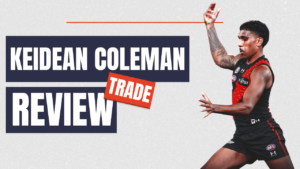
Keidean Coleman is a dynamic presence for the Brisbane Lions, particularly noted for his smooth and effective play-off half-back. His teammates prefer getting the ball into his hands, recognizing his ability to efficiently rebound out of the defensive 50 and initiate the team’s forward movements. Coleman’s skill set is highlighted by his penetrating kick, which, combined with his strong football IQ, allows him to take the game on confidently.
He possesses the unique ability to create scoring opportunities seemingly out of nowhere, utilizing his agility and game sense to turn defensive plays into offensive advantages. His role as a key playmaker in transitions from defence to attack makes him an invaluable asset to the Lions, often the catalyst for their most effective and unexpected forward thrusts.
Looking at his fantasy footy stats for 2023, you can get some small glimpses of what the community hopes turns into his new normal this year. In AFLFantasy, he averaged 69.3, which consisted of two tons, including a season-high 111 against Richmond. While in SuperCoach, he averaged 71.3 and scored three tons. At first glance, these scores don’t create great excitement; in isolation, they shouldn’t.
But it’s the splits of what he did over the season’s final few months that have caught the attention of the fantasy community. Over the final seven rounds of the home and away season, Kiddy averaged 89.2 in AFLFantasy/DreamTeam and 90.1 in SuperCoach, an increase of almost 20 points compared to his current starting price.
Further to this, his AFL series was even stronger. He averaged 102 in AFL Fantasy and 106 in SuperCoach, including a 127 in the AFL Grand Final, his season and career-high score. If you contrast this three-game average to his starting price, it’s a potential upside of 32.7 points per game in AFLFantasy and 34.7 in SuperCoach.
Kiddy’s journey in the fantasy landscape has showcased a trajectory of promising scoring potential, evident in his performances throughout his career. In 2022, Coleman’s average in AFLFantasy was a commendable 77.7, highlighted by two scores over 100 and four additional scores in the solid range of 90-99. This performance underlines his ability to contribute consistently high scores, making him a valuable asset in fantasy leagues.
In the SuperCoach format, Coleman’s performance was even more notable. He averaged 84, achieving four tons over the season. This included an impressive streak of three consecutive weeks where he hit the hundred mark, a testament to his scoring consistency and potential. Additionally, Coleman scored six more times with totals of 85 and above, reinforcing his capability as a reliable scorer in the SuperCoach format.
If you’ve found yourself in the market for a defender with premium scoring potential in the breakout range, Kiddy must be a player of consideration in your starting squad.
Kiddy Coleman represents undeniable value in the fantasy football community, especially considering his performance in the final months of 2023 and during the finals series. His starting price, juxtaposed with his elevated scoring during this period, fuels excitement about his potential to reach premium levels.
The major challenge, however, lies in navigating his early bye-round in Round 2, which he shares with Carlton. This complicates decisions, particularly when considering other popular ‘value’ selections like Sam Walsh and Zac Williams from Carlton. Balancing these picks is crucial, as starting two or more of these players could increase the risk of relying on lower-scoring rookies during the critical best 18 weeks.
The key lies in prioritizing Coleman, Walsh, and Williams based on their importance to your team’s strategy, which will help determine if starting with Coleman is viable.
There’s always the possibility of trading into Coleman after the Round 2 bye. He could be an excellent choice for early trades, especially if you need to replace an underperforming mid-priced player in another line. This strategy allows you to capture value while managing risk effectively.
The conversation this preseason has largely centred around forwards, but the strategy for defenders should be noticed. Decisions here must be intentional, not just residual effects of choices in other lines. Considerations such as whether to start or fade Nick Daicos, who also has an early bye, are important.
Similarly, the ongoing relevance of top-line defenders like Tom Stewart, Jack Sinclair, and James Sicily needs to be assessed. Hayden Young, Zac Williams, Hayden Chapman, and various cash cows all factor into this narrative. Coleman’s potential inclusion in your team should align with these broader strategic considerations.
Coleman should be on your watchlist and considered for your team. If you need more confidence about managing trades around the early bye rounds, it might be prudent to look elsewhere but keep a close eye on Coleman. His performance could warrant early inclusion in your team, even if he’s not part of your initial starting lineup.
In the context of preseason discussions for salary cap formats, Kiddy Coleman is being touted as a potential D3 pick. However, securing him as a D4 would be ideal, offering a balance between value and performance.
While there may be a bullish sentiment to select him as a D2 due to his upside, placing such high expectations on him could be a stretch. Playing it slightly safer with a D3 pick allows leveraging his potential without overcommitting too early in the draft.
JOIN THE CONVERSATION
Do you believe he is fantasy-relevant? Will you be starting with him? Have your say on our Facebook, Twitter or Instagram.
WANT EARLY ACCESS?
Want access 24 hours early to the 50 Most Relevant podcasts? Join our Patreon and get ahead of the crowd here.
Explore the strategic fantasy football potential of Jayden Short, Richmond Tigers’ key defender, as we analyze his evolving role in the team’s dynamics and the impact of new coaching strategies under Adam Yze.
Delve into how Short’s significant market share, potential growth areas, and favourable early bye-round position him as both a reliable starter and a valuable upgrade target in your fantasy lineup.

WHY IS HE RELEVANT?
Jayden Short is known for his dynamic style and impactful skills in the field. In 2023, Short remained a solid contributor to his team despite being restricted to 16 games due to a hamstring injury. Known for providing significant drive-off half-back, he has also shown versatility by spending much of 2022 in the midfield, demonstrating his adaptability and the breadth of his football abilities.
Short had a notable year in terms of fantasy statistics for 2023. In AFLFantasy, he averaged 92.5, with six scores over 100, including a season-high of 123, and only four scores under 80. This performance places him as the 11th-ranked defender by average for the current year. In SuperCoach, his average was an impressive 98.6, with eight tons, three of which were over 120, and only twice did his scoring dip below 80, ranking him 9th among defenders.
Highlighting Short’s resilience and scoring potential, it’s noteworthy to consider the impact of his injury. Specifically, in Round 16, he was subbed out before halftime due to a hamstring strain. Excluding this game, his seasonal averages would have been even higher – around 97 in AFLFantasy and 102 in SuperCoach. This adjustment underscores his scoring capacity even amidst adversity.
Short has been a model of consistency in the past three seasons, maintaining an average of 90+ across all formats and demonstrating prolonged periods of high scoring. Notably, before his injury-affected 2023 season, he had not missed a game for three consecutive seasons, showcasing his durability and reliability.
Jayden Short is a multifaceted option in a fantasy football community that values various attributes. He offers value for coaches looking for an efficient pick, consistency for those seeking stable scorers, a high-scoring ceiling for those aiming for big points, a dependable scoring floor, and a uniqueness that sets him apart from the pack. Short’s comprehensive skill set and proven track record make him a compelling choice in 2024, offering a blend of qualities that cater to a wide range of strategic needs and preferences.
Jayden Short’s role within the Richmond Tigers has seen experimentation over the past seasons. Still, with the arrival of Tim Taranto and Jacob Hopper, he has been repositioned back to his preferred halfback role. This shift is crucial, as Short has been integral to Richmond’s strategy, evidenced by his significant market share of the team’s fantasy points.
In AFLFantasy/DreamTeam, he accounted for 6.2% of the Tigers’ points last year, slightly down from 6.6% the previous year when he had more midfield responsibilities. This market share percentage is critical, indicating that Short remains one of Richmond’s primary ball users and a top contributor to their fantasy scoring, regardless of his specific role.
The arrival of new coach Adam Yze at Richmond has brought promises of ‘changing things up.’ However, according to those observing Richmond’s training sessions, these changes are unlikely to impact Short’s role significantly. He will continue in his effective halfback rebounding role, where he has already scored at a premium level.
Under Yze’s leadership, there’s potential for Short’s game to evolve further. One possible growth area is taking a more significant share of kick-ins; Short took 31 last year, less than teammates Dan Rioli and Nick Vlaustin.
Another potential growth area could stem from an overall evolved team game style. Under former coach Damien Hardwick, Richmond was among the lowest-scoring teams in total fantasy points. If Yze can enhance the team’s scoring, and assuming Short maintains his market share, there’s a path for him to not only push his average above 100 but potentially towards 110.
A key consideration is navigating the early bye rounds due to the AFL’s scheduling. Fortunately, the Tigers have their bye in round 6, which is relatively favourable compared to other early bye rounds. Starting premiums from teams with early byes is feasible but requires strategic team structuring.
Given Short’s history of scoring in the mid-high 90s and the early-season price dynamics, he is unlikely to significantly increase prices rapidly. This makes him a viable upgrade target post the round 6 bye for coaches who choose not to start with him.
Jayden Short is a reliable D1 option across both AFLFantasy and SuperCoach formats. His consistent high scoring and versatility on the field make him a top pick for any fantasy manager looking to solidify their defence with a dependable and impactful player.
JOIN THE CONVERSATION
Do you believe he is fantasy relevant? Will you be starting with him? Have your say on our Facebook, Twitter or Instagram.
WANT EARLY ACCESS?
Want access 24 hours early to the 50 Most Relevant podcasts? Join our Patreon and get ahead of the crowd here.